
Signs Your Facility Has Outgrown Its Layout
How inefficient grow room design quietly limits yield, labor efficiency, and canopy potential
In controlled environment agriculture, most growers spend years dialing in the variables that directly affect plant performance: lighting intensity, irrigation strategy, environmental control, genetics, and nutrition. But there’s one variable that often remains untouched long after everything else has been optimized: the facility layout.
The reality is that many cultivation facilities were designed during an earlier stage of the business. What worked for a startup cultivation room or an early-stage facility may no longer support today’s operational goals. As production increases, staff grow, and cultivation strategies change, the original layout can quietly become one of the biggest bottlenecks in the operation.
In mature cultivation operations, layout inefficiencies are rarely subtle. We regularly see facilities operating with 60–70% effective canopy utilization, excessive labor movement, and inconsistent environmental performance across rooms. In many cases, these constraints are not biological or genetic limitations, but structural ones built into the facility design itself.
When a facility outgrows its layout, the signs tend to show up across multiple areas, from workflow inefficiencies and labor slowdowns to underutilized vertical space and inconsistent canopy management.
Here are some of the most common indicators that your facility’s layout may be limiting your production potential.
1. Your Team Is Constantly Working Around Fixed Aisles
Many cultivation rooms are designed with permanent aisles between every row of plants. While this may seem logical during the initial design phase, fixed aisles quickly become one of the largest sources of wasted space in a cultivation facility.
In traditional layouts, permanent aisles can consume 30–40% of total floor space. For context, traditional fixed-bench layouts often operate at 60–70% canopy utilization, meaning up to 40% of conditioned space is not generating revenue. In contrast, optimized mobile systems can increase usable canopy to 80–90% of total floor area by reducing aisle redundancy.That space doesn’t contribute to plant production, yet it still requires lighting, HVAC capacity, and environmental control. In a 10,000 sq ft flower room, that difference can represent an additional 2,000–3,000 sq ft of active canopy without expanding the building footprint.
As production scales, growers often realize that valuable square footage is being dedicated to walkways instead of the canopy.
If your team regularly comments on how much empty floor space exists between rows, or if you find yourself wishing you could fit just a few more benches in the room, it’s a strong signal that the layout is no longer optimized.
2. You’re Running Out of Canopy Space Without Expanding the Building
One of the clearest indicators that a facility has outgrown its layout is when production demand increases but canopy space stays fixed.
Many operators immediately assume the only solution is to build additional rooms or expand the facility footprint. However, expansion projects are expensive, time-consuming, and often limited by regulatory approvals.
In reality, many facilities already have untapped capacity within their existing structure.
The most common missed opportunity is vertical space.
Cultivation rooms often have ceilings high enough to accommodate additional plant tiers, but those vertical dimensions go unused in single-level bench systems. That said, not every cultivation strategy is immediately compatible with vertical expansion. Factors such as plant architecture, trellising requirements, lighting intensity, and HVACD capacity all influence how effectively additional tiers can be implemented.
When properly designed, multi-tier systems can increase canopy per square foot by 1.5x to 2.5x, depending on tier count and crop type, but these gains must be supported by appropriate environmental and irrigation infrastructure.
Facilities with 16–20 ft clear heights and controlled, repeatable cultivation SOPs tend to see the greatest benefit. If your facility has significant overhead clearance above the canopy, it may be an indication that the room was designed for horizontal production rather than vertical efficiency.
3. Workflow Feels Slower Than It Should
As facilities scale, workflow efficiency becomes just as important as plant performance.
In an optimized grow room, tasks such as pruning, scouting, irrigation checks, and harvesting should move in a logical and consistent flow. When layouts become outdated, these workflows start to break down.
Some common symptoms include:
- Employees traveling long distances between tasks
- Bottlenecks during harvest days
- Teams waiting for access to specific rows
- Equipment is constantly being repositioned
Over time, these inefficiencies add up to significant labor costs and lost productivity. In large-scale cultivation environments, inefficient layouts can increase labor hours per pound by 15–30%. These inefficiencies often go unnoticed because they are distributed across daily tasks, but over time, they represent one of the highest hidden operational costs in the facility.
If your staff frequently has to maneuver around obstacles or wait for access to certain plant rows, the physical layout may be creating friction in your daily operations.
High-performing facilities design workflows so that tasks move linearly through the room, minimizing backtracking, congestion, and idle time.
4. Harvest and Maintenance Tasks Are Becoming More Difficult
When plant density increases without proper layout planning, routine tasks can become more difficult.
Tight rows, awkward reach distances, and limited access points can make simple activities like defoliation or plant inspections more time-consuming. Harvest days, in particular, can become chaotic if teams struggle to access plants efficiently.
These challenges are often a result of layouts that weren’t designed to support higher plant density or scaled production workflows.
As cultivation operations mature, they require infrastructure that supports repeatable, efficient movement through the crop, not layouts that force workers to constantly adapt.
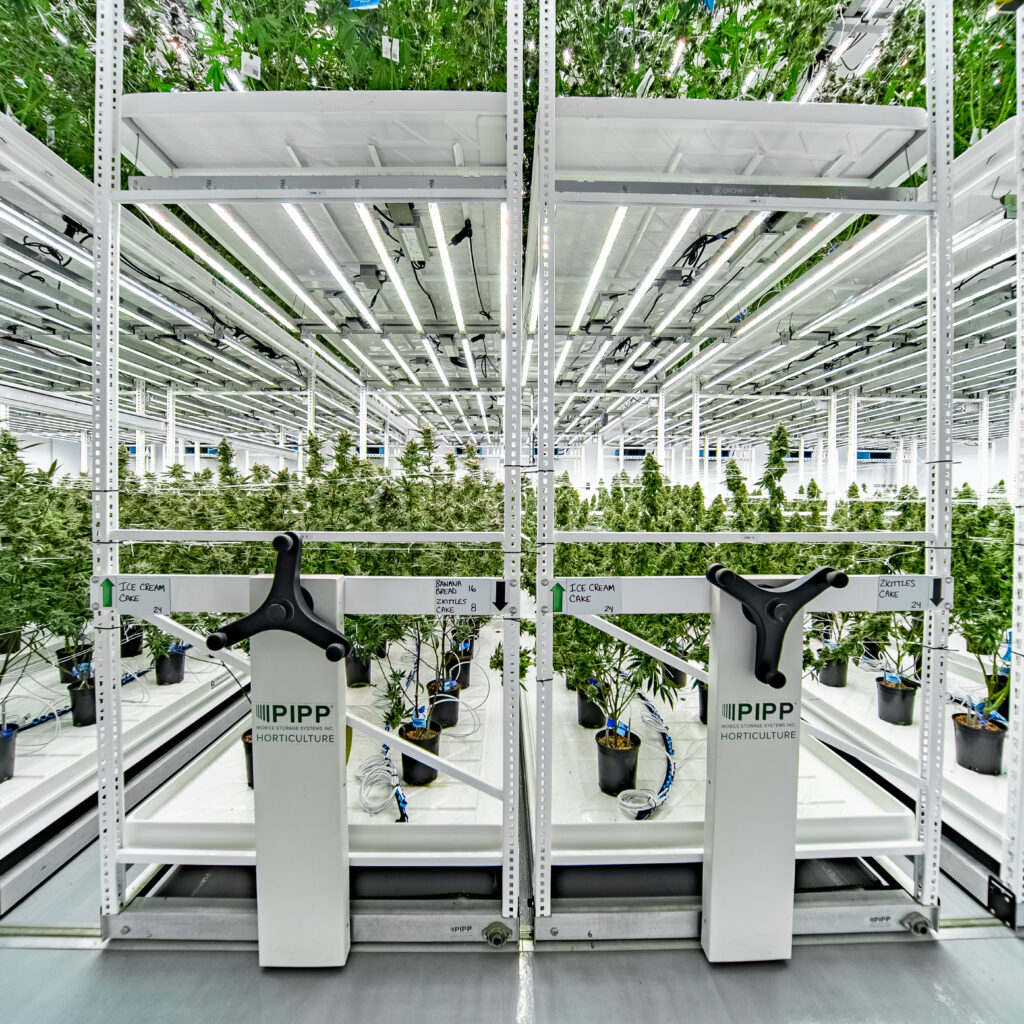
For example, in facilities where harvest teams must work across multiple fixed aisles simultaneously, it is common to see congestion, uneven pacing between crews, and delays in processing. In contrast, organized row access and controlled aisle exposure can significantly improve harvest flow and consistency.
5. Environmental and Lighting Uniformity Is Hard to Maintain
Layout inefficiencies can also impact environmental consistency.
In crowded rooms with inconsistent spacing, airflow patterns can become uneven. Certain areas may experience stagnant air, while others receive excessive circulation. Lighting uniformity can also suffer when plant rows are squeezed into layouts that weren’t originally designed to support higher canopy density.
Over time, these inconsistencies can lead to:
- Uneven plant growth
- Microclimate pockets within the canopy
- Variations in yield across the room
These issues are often compounded in high-density environments where airflow design has not been adjusted to match the canopy structure. Target air velocities, distribution patterns, and dehumidification capacity must all be aligned with plant density to maintain uniform conditions across the room.
When growers notice that plants perform differently depending on where they’re located in the room, it may be a sign that the layout is no longer supporting uniform cultivation conditions.
Increasing canopy density without adjusting HVACD and airflow strategy can lead to elevated disease pressure, inconsistent transpiration rates, and variability in final product quality.
The Modern Solution: Vertical Mobile Racking Systems
When facilities reach the point where layout limitations begin affecting productivity, the most effective solution is often rethinking how canopy space is structured. While there are several ways to improve facility layout, including workflow redesign and fixed bench optimization, many operators reach a point where incremental changes are no longer sufficient to meet production goals.
Modern cultivation facilities are increasingly adopting vertical mobile racking systems designed specifically for high-density plant production.
These systems address the two biggest inefficiencies in traditional layouts: unused vertical space and wasted aisle area.
Eliminating Permanent Aisles
Mobile racking systems allow rows to move along floor-mounted tracks, creating a single active working aisle instead of permanent walkways between every row.
This design can significantly increase usable canopy space by eliminating fixed aisles and dedicating more square footage to plant production. In many cases, operators implementing mobile racking systems see canopy increases of 20–40% within the same footprint. When combined with improved workflow efficiency, this can significantly increase output per room while reducing labor cost per unit of production.
Instead of designing around multiple walkways, growers gain the flexibility to open an aisle only where work is happening.
The result is often a shorter path to ROI compared to facility expansion, which typically involves higher capital costs, longer timelines, and regulatory complexity.
Expanding Canopy Through Vertical Tiers
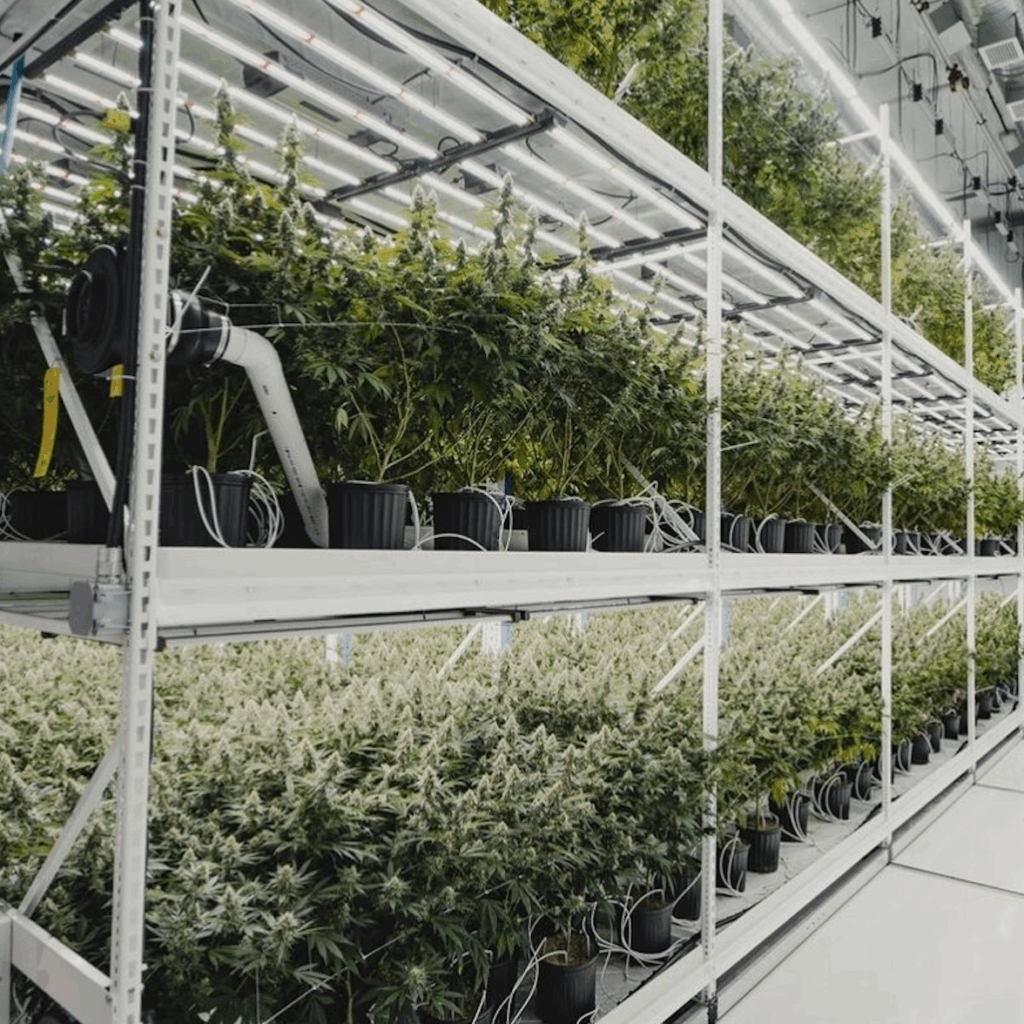
In addition to improving floor efficiency, vertical grow racks allow growers to stack multiple cultivation tiers within the same footprint.
By using vertical space, facilities can dramatically expand canopy capacity without increasing the building size.
Depending on ceiling height and cultivation strategy, multi-tier systems can support two or more levels of plant production, effectively multiplying canopy area within the same room.
However, increasing canopy density also increases system demand. Lighting, irrigation, and HVACD systems must be properly designed to support the additional plant load. Without this alignment, facilities risk trading space efficiency for environmental instability.
For operators facing space constraints, this approach can be one of the most impactful ways to increase production capacity without expanding the facility.
Here’s how expanding through vertical tiers has helped other facilities
Improving Workflow and Operational Efficiency
Beyond canopy expansion, mobile racking systems can also improve how teams move through the grow room.
With a single accessible aisle and an organized row structure, staff can move efficiently through tasks like scouting, pruning, and harvesting. Equipment can be transported more easily, and workflows become more predictable.
For facilities managing large-scale production cycles, these operational improvements can translate directly into lower labor costs and faster crop turns.
Facilities that successfully align layout with workflow often see measurable improvements in labor efficiency, reduced task time variability, and more predictable harvest cycles.
Designing for the Future of Cultivation
As the controlled environment agriculture industry continues to change, facility design is becoming just as important as cultivation strategy.
Growers who once focused exclusively on plant science are increasingly recognizing the value of infrastructure that supports scalable production.
Layouts that maximize canopy space, streamline workflows, and maintain environmental consistency provide a strong foundation for long-term operational success.
If your facility is showing signs of spatial limitations, labor inefficiencies, or underutilized vertical space, it may be time to reconsider how the grow room is structured.
Upgrading to a modern vertical racking system isn’t just about fitting more plants into the room; it’s about designing a cultivation environment that allows both plants and operations to perform at their highest potential.
When Vertical Mobile Racking Makes Sense
While vertical mobile racking systems can provide significant advantages, they are not universally applicable. The best results are typically seen in facilities that meet several key criteria:
- Adequate ceiling height (typically 16 ft or greater)
- Standardized cultivation practices across rooms
- High labor cost environments where efficiency gains are meaningful
- Facilities constrained by space or unable to expand
Conversely, single-tier systems may remain appropriate for:
- Boutique or large-plant cultivation strategies
- Facilities with limited vertical clearance
- Operations prioritizing maximum plant size over canopy density
Frequently Asked Questions
What is a vertical grow rack system?
A vertical grow rack system is a cultivation infrastructure solution that allows plants to be grown on multiple tiers within the same footprint. By using vertical space, these systems increase total canopy area without requiring facility expansion.
How do mobile grow racks increase canopy space?
Mobile grow racks eliminate permanent aisles by allowing rows to move along tracks. Instead of having fixed walkways between every row, a single working aisle opens where access is needed. This design significantly increases the amount of floor space dedicated to plant production.
How much additional canopy can vertical racking provide?
The increase depends on ceiling height, crop type, and tier configuration, but many facilities can significantly expand canopy capacity by combining multi-tier growing with mobile racking systems that reduce unused aisle space.
Are vertical grow racks only used in cannabis cultivation?
No. Vertical racking systems are used across a wide range of controlled environment agriculture sectors, including leafy greens, propagation, tissue culture, and other high-density plant production systems.
What should growers consider before transitioning to vertical racks?
Key considerations include ceiling height, lighting strategy, irrigation design, workflow planning, and environmental control. A properly designed system integrates all of these factors to support efficient multi-tier cultivation.
Can mobile racking systems improve workflow efficiency?
Yes. By organizing rows in a structured layout and creating a single accessible aisle, mobile racks allow staff to move efficiently through the grow room. This can reduce travel time, improve task organization, and streamline harvesting and maintenance workflows.
When is the right time to upgrade a cultivation layout?
Growers should evaluate their layout when they notice signs such as limited canopy capacity, inefficient workflows, underutilized vertical space, or increasing labor challenges. These indicators often suggest that the facility has outgrown its original design.
Evaluate Your Canopy Potential
If your facility is experiencing space limitations, workflow slowdowns, or underutilized vertical space, it may be time to reassess how your grow rooms are designed. Modern vertical mobile racking systems allow cultivators to unlock more canopy within the same footprint while improving operational efficiency.
If your facility is experiencing layout-related constraints, a structured evaluation of canopy utilization, workflow efficiency, and environmental performance can help identify the highest-impact opportunities for improvement.
Pipp Horticulture works with cultivation teams to assess existing layouts and design systems that align with both production goals and operational realities.
Explore how vertical mobile racking can transform your cultivation layout.
Get a FREE Grow Consultation
Lorem ipsum dolor sit amet, consectetur adipiscing elit. Ut elit tellus, luctus nec ullamcorper mattis, pulvinar dapibus leo.