
Indoor Cultivation: Integrating Lighting, Airflow, and Mobility
Successful indoor cultivation starts long before the first seed is planted. From seed to structure, every element of the cultivation environment should be designed to work together.
It begins with the structure of the cultivation environment itself. More precisely, it begins by defining the production strategy and designing the cultivation environment around the crop.
Lighting, airflow, irrigation, environmental controls, plant spacing, and employee access all influence how effectively a crop can be managed. Yet these systems are sometimes planned independently, creating facilities where individual pieces of equipment perform well but the room as a whole does not operate efficiently.
As controlled environment agriculture (CEA) becomes more sophisticated, growers have an opportunity to take a more integrated approach.
Instead of asking only how much light a crop needs or how many plants can fit inside a room, cultivation teams can ask a broader question:
How should the crop, cultivation recipe, environmental systems, and physical infrastructure work together throughout the plant’s life cycle?
For commercial indoor growers, answering that question can influence plant performance, environmental consistency, labor efficiency, space utilization, and the ability to adapt a facility as production needs change.
An important starting point is recognizing that the cultivation recipe itself is an engineering input. Plant density, finished canopy height, target PPFD and DLI, photoperiod, environmental setpoints, CO₂ strategy, irrigation volume, substrate strategy, anticipated transpiration, and labor workflow all influence the infrastructure required to support the crop. These assumptions should form part of the project’s Basis of Design rather than being determined after major mechanical and cultivation systems have already been selected.
Why Integrated Cultivation Design Matters
Controlled environment agriculture gives growers the ability to influence many of the variables surrounding a crop, including light, temperature, humidity, irrigation, CO₂, root-zone conditions, and air movement.
But controlling those variables individually does not automatically create an optimized growing environment.
The plant experiences them simultaneously.
A change in lighting intensity can affect plant energy balance and transpiration. Increasing plant density can change airflow through the canopy. Adding another cultivation tier changes the physical relationship between lights, plants, airflow equipment, irrigation infrastructure, HVAC distribution, drainage, and employees.
The cultivation structure therefore becomes part of the environmental system.
This is particularly important in mobile vertical grow systems, where multiple cultivation levels allow growers to increase productive canopy within the same facility footprint.
The objective isn’t simply to fit more plants into a room.
It is to create a system where the additional canopy can still receive the light, airflow, irrigation, environmental control, and employee access required for consistent production.
Additional canopy should only be considered productive canopy if the facility can support it environmentally and operationally. Increasing theoretical canopy while compromising environmental uniformity, irrigation consistency, crop access, sanitation, scouting, or harvest throughput does not necessarily increase productive output.
Lighting: Designing Around the Canopy
Lighting is one of the fundamental inputs of indoor cultivation.
Modern LED technology allows growers to manage variables such as light intensity, photoperiod, spectrum, fixture placement, and distance from the canopy with much greater precision than previous generations of indoor cultivation technology.
For cultivators, those variables are better understood through measurements such as photosynthetic photon flux density (PPFD), daily light integral (DLI), photoperiod, spectrum, and spatial uniformity across the canopy.
But fixture performance alone does not determine the lighting environment experienced by the plant.
Cultivation teams also need to consider:
- Canopy height
- Plant spacing
- Cultivation tier spacing
- Fixture-to-canopy distance
- Light uniformity
- Cultivar characteristics
- Vegetative versus flowering requirements
- Heat generated within each cultivation level
- Interaction with irrigation and airflow equipment
- CO₂ concentration and environmental setpoints
- Canopy architecture and light interception
Average PPFD alone can also be misleading. A room can achieve an acceptable average while still containing significant hot and cold spots. For commercial cultivation, uniformity across the canopy is critical to achieving consistent morphology, quality, and yield.
This becomes especially important in multi-tier cultivation.
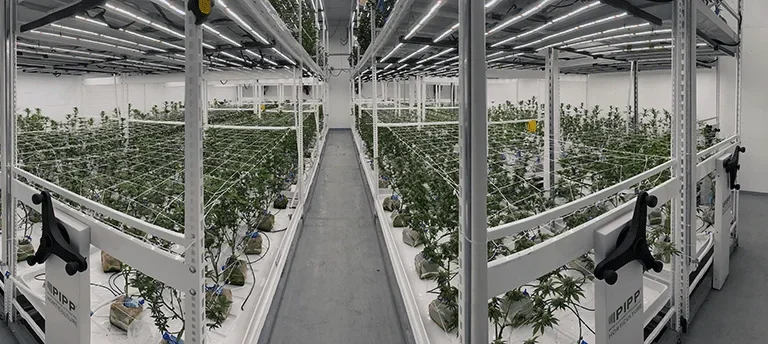
Rather than lighting an entire room from overhead, each cultivation level can function as its own growing environment. Lights can be positioned relative to the canopy while racks, trays, irrigation, and airflow systems are organized around that environment.
PIPP Horticulture’s Vertical Grow Racks are designed to integrate with essential cultivation equipment including LED lighting, irrigation, plumbing, and airflow systems.
That integration allows the cultivation structure to become the framework supporting the plant environment rather than simply shelving holding plants.
Airflow: Managing the Microclimate Around the Plant
Lighting provides energy to the plant, but airflow helps shape what happens around the leaf surface and within the canopy.
Air movement can influence:
- Leaf temperature
- Transpiration
- Gas exchange
- CO₂ availability around the leaf
- Humidity distribution
- The leaf boundary layer
- Water and mineral transport associated with transpiration
- Canopy microclimates
Air movement should not, however, be confused with environmental conditioning. Circulation equipment redistributes heat, moisture, CO₂, and conditioned air. It does not remove the sensible and latent loads generated within the cultivation environment. Cooling and moisture removal remain functions of the HVACD system.
This distinction is important because adding circulation fans is not necessarily the solution to a room struggling with temperature or humidity control. The goal is to coordinate HVACD, air distribution, and canopy-level circulation so conditioned air reaches the crop and heat and moisture can effectively move out of the canopy.
One of the challenges in dense indoor cultivation is that room-level environmental conditions do not necessarily represent conditions inside the canopy.
A temperature or humidity sensor mounted on a wall may indicate that a room is operating within target parameters while conditions between plants, or between different cultivation tiers, may be different.
As canopy density increases, leaves and plant material can restrict air movement and create localized microclimates.
Recent research reinforces the importance of treating airflow as a measurable cultivation variable. A 2026 vertical-farming study examining LED spectrum and targeted airflow found that airflow affected photosynthesis, gas exchange, water-use efficiency, and biomass responses, and that those responses could differ depending on the lighting environment.
Importantly, the study should not be interpreted as establishing a universal airflow prescription. It reinforces a broader principle: plant responses to airflow can depend on the crop, lighting environment, and other production variables.
The implication for facility design is important:
Lighting and airflow should not necessarily be optimized independently.
PPFD, DLI, spectrum, and photoperiod can influence plant physiology and transpiration demand, while the developing canopy changes how air moves through the cultivation environment.
PIPP has also been studying this relationship directly.
In partnership with the Cannabis Research Center & Coalition, PIPP participated in a controlled cannabis airflow study designed to better understand how canopy-level air velocity affects plant performance.
Learn more in Replacing Myths with Data: What Cannabis Growers Can Finally Learn About Airflow.
From Room Airflow to In-Rack Airflow
Traditional cultivation rooms frequently rely on wall-mounted, ceiling-mounted, or oscillating fans to circulate air.
These approaches can create air movement throughout the room, but dense plant canopies and vertical structures can make uniform canopy-level airflow more difficult to achieve.
In a vertical environment, each cultivation tier can develop its own distinct microclimate if air distribution is not properly designed.
That changes the airflow challenge.
Instead of simply moving air around the room, growers may need to think about how air travels through and across each plant canopy, how that airflow changes as biomass develops, and how heat and moisture are transported back toward the environmental system.
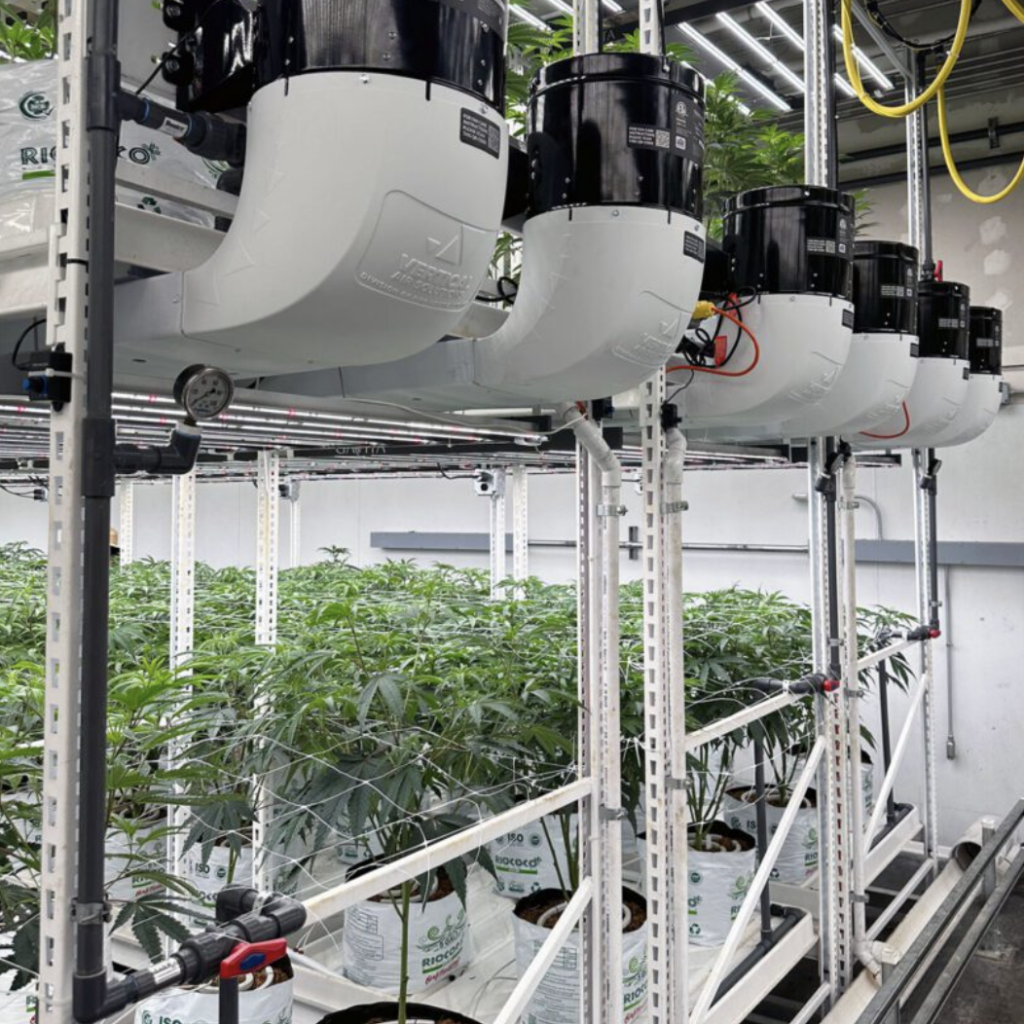
PIPP’s In-Rack Airflow Systems integrate air circulation directly into mobile vertical racking. This allows airflow infrastructure to operate closer to the crop while maintaining valuable cultivation space.
It also helps address one of the central challenges of multi-tier cultivation: maintaining environmental consistency as productive canopy increases.
The objective is not maximum air velocity. It is appropriate and consistent canopy-level air movement throughout the crop cycle.
HVACD: Supporting the Biological Load
Airflow cannot be evaluated independently from HVACD.
Plants transpire substantial amounts of water into the cultivation environment. That moisture becomes latent load that the facility must remove while also managing the sensible heat generated by lighting, equipment, and other sources.
As productive canopy, lighting intensity, irrigation volume, or plant transpiration increases, the environmental system may need to manage correspondingly greater loads.
This becomes particularly important when converting a single-tier room to multi-tier cultivation. Adding tiers does not simply mean adding more racks and lights. The facility must also be evaluated for cooling, dehumidification, electrical capacity, irrigation capacity, drainage, CO₂ delivery, air distribution, and control capability.
A room is not optimized simply because additional canopy physically fits inside it. The environmental system must be capable of maintaining the cultivation strategy when the crop reaches peak biomass and transpiration.
Mobility: Turning Floor Space Into Productive Canopy
Lighting and airflow support the plant environment.
Mobility changes how efficiently that environment can use the building.
Traditional fixed cultivation layouts require permanent aisles between rows so employees can access plants.
Those aisles consume floor space even when no one is using them.
Mobile cultivation systems change that equation.
By placing cultivation racks on mobile carriages, growers can open an aisle where access is needed and close unused aisles elsewhere.
Rather than dedicating large portions of the room permanently to walkways, more of the facility footprint can potentially become productive cultivation space.
When mobility is combined with vertical cultivation, growers can optimize space in two directions:
Horizontally, by reducing unnecessary fixed aisle space.
Vertically, by adding cultivation levels within the available room height.
The result is a cultivation environment designed around cubic space rather than floor area alone.
However, cubic-foot utilization should not become the objective in isolation. The more meaningful metric is how much repeatable, manageable, high-performing canopy the complete production system can support.
Mobility Is Also About Access
Increasing plant density only works if employees can still safely and efficiently interact with the crop.
Cultivation teams need access for tasks such as:
- Scouting
- Irrigation inspection
- Plant training
- Pruning
- Integrated pest management
- Cleaning
- Maintenance
- Harvesting
Poor access creates operational friction, and that friction eventually appears as additional labor cost, missed scouting opportunities, inconsistent plant work, sanitation challenges, or reduced productivity.
This is why mobility should not be viewed simply as a strategy for increasing plant counts.
It is also a workflow strategy.
A properly planned mobile system creates access where employees need it while allowing the remainder of the room to remain dedicated to production.
For multi-level environments, access to elevated cultivation areas becomes another important consideration.
The ELEVATE® Platform System provides an integrated platform solution designed to help cultivation teams work within multi-tier growing environments.
Facility designers can therefore evaluate plant density and employee access together instead of sacrificing one for the other.
Grow Trays Connect the Systems
One component that can easily be overlooked in integrated cultivation design is the grow tray.
Yet trays sit directly at the intersection of several critical systems.
PIPP Grow Trays provide connection points for lighting, air circulation, and plumbing while supporting irrigation and drainage requirements.
In a well-designed vertical cultivation environment, trays therefore do more than hold plants.
They help organize the infrastructure surrounding the crop.
This modular approach can simplify how lighting, airflow, irrigation, drainage, and plant positioning are incorporated into each cultivation level.
The tray also establishes a repeatable production plane at each tier, making drainage, irrigation distribution, plant positioning, sanitation, and infrastructure coordination part of the cultivation system rather than an afterthought.
Irrigation and the Root Zone
Irrigation should not be viewed simply as plumbing attached to a rack. The root zone is another controlled environment.
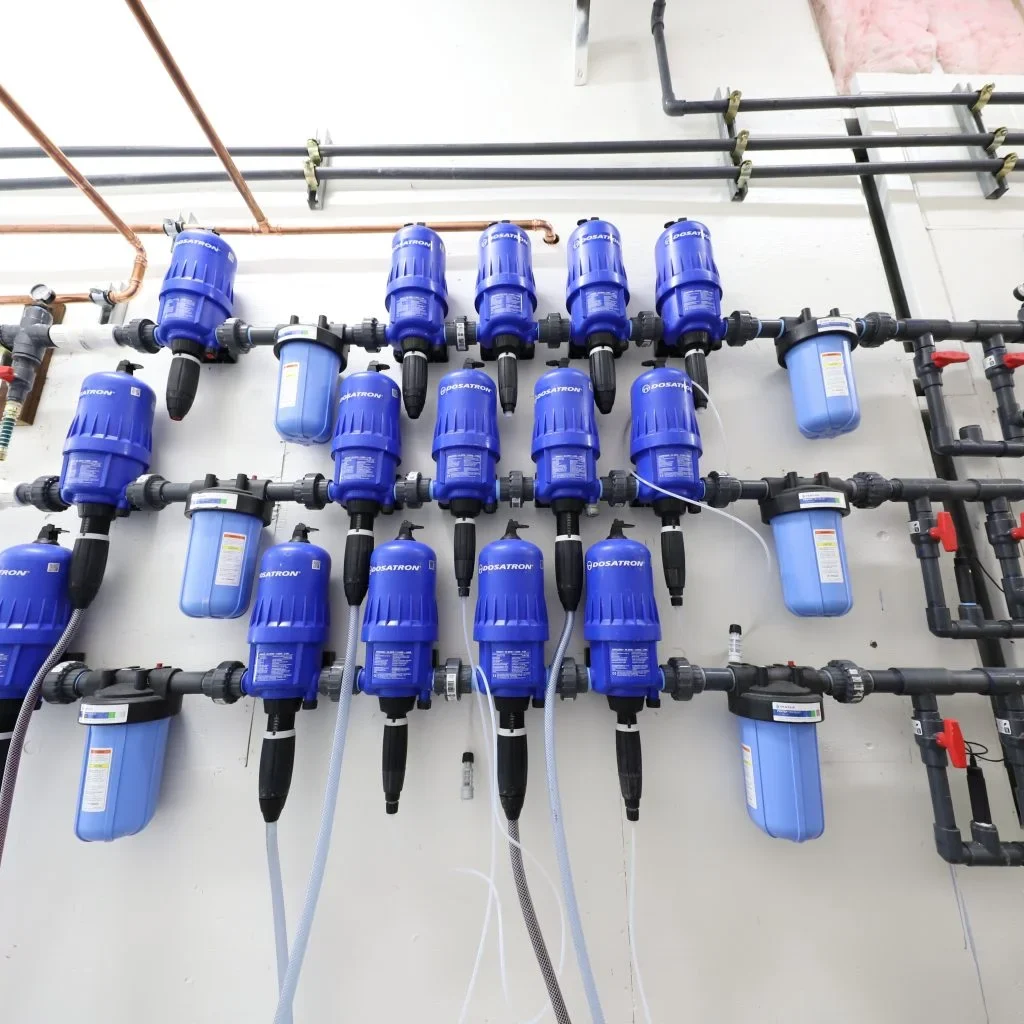
Substrate volume, volumetric water content, pore-water EC, irrigation event size and frequency, dryback strategy, drainage, and root-zone temperature can all influence crop performance.
Irrigation also interacts directly with facility engineering. Water delivered to the crop ultimately leaves the system through drainage, plant biomass, evaporation, or transpiration. Moisture released through evapotranspiration becomes latent load that the HVACD system must manage.
For that reason, peak irrigation volume and realistic transpiration assumptions should be considered during mechanical design rather than after HVACD equipment has already been selected.
Designing for the Plant's Life Cycle
A cultivation facility should also recognize that plants do not remain static.
The environment surrounding a young plant is very different from the environment surrounding a mature canopy.
As plants develop:
- Leaf area increases
- Canopies become denser
- Light interception changes
- Airflow pathways change
- Water demand changes
- Transpiration changes
- Employee access requirements change
The environmental load generated by the crop also changes. A newly transplanted room and a mature flowering room may occupy the same physical space while behaving very differently from a mechanical and biological perspective.
Research into vertical farming increasingly supports the concept of dynamic environmental control rather than assuming that a single environmental strategy should remain unchanged throughout production.
In practice, sophisticated cultivators already account for this by adjusting environmental, lighting, irrigation, and crop-management targets as the plant develops.
The physical cultivation system should provide similar flexibility.
Mobile and modular infrastructure gives operators more opportunities to adjust layouts, plant spacing, tier configurations, and workflows as production requirements evolve.
Lighting + Airflow + Mobility: One Cultivation System
The strongest indoor cultivation facilities are not necessarily the ones with the most equipment.
They are the ones where equipment works together.
Consider the relationship:
Lighting supplies the energy driving plant growth.
Airflow helps manage the microenvironment surrounding the canopy.
HVACD removes the sensible and latent loads generated by the cultivation environment.
Irrigation manages the root-zone environment while also influencing crop transpiration and facility moisture loads.
Mobility allows more productive canopy to occupy the available building footprint while maintaining access.
Vertical structure organizes those systems within the available cubic space.
When those components are designed together, the facility becomes more than a collection of racks, lights, fans, and irrigation lines.
It becomes an integrated cultivation platform.
Avoid Designing Systems in Isolation
One of the most expensive mistakes in facility planning can occur when major systems are specified independently.
For example, a cultivation team may determine rack dimensions first, select lighting later, design HVAC separately, and address airflow only after plants are already in the room.
Each decision affects the others.
Increasing canopy density may change cooling and dehumidification requirements.
More specifically, increasing productive canopy can increase lighting load, irrigation demand, transpiration and latent load, CO₂ demand, electrical demand, and labor requirements.
Changing tier spacing affects fixture placement and plant clearance.
Plant growth changes airflow resistance.
Additional tiers create additional irrigation, drainage, electrical, and maintenance requirements.
Mobile equipment changes how utilities and infrastructure need to interact with the cultivation area.
The earlier these relationships are considered, the easier it becomes to design a facility around the complete production system.
This is why cultivation and engineering teams should establish realistic Basis of Design assumptions together before equipment is specified. The mechanical engineer needs realistic cultivation inputs, and the cultivation team needs to understand the mechanical limits within which its production strategy must operate.
Measure Conditions Where Plants Experience Them
Another important principle is measurement.
Room-level environmental readings provide valuable information, but growers should also understand conditions where plants are actually growing.
For lighting, this means evaluating PPFD distribution and DLI at canopy level rather than relying only on fixture specifications.
For airflow, it means measuring air velocity around and within the canopy instead of assuming that visible leaf movement represents adequate circulation.
For temperature and humidity, it means understanding whether conditions vary between cultivation tiers, rows, or dense sections of the canopy.
For irrigation, it means validating emitter delivery, substrate response, drainage, and root-zone conditions rather than assuming that the programmed irrigation volume is being delivered uniformly to every plant.
PIPP explores this concept further in Beyond Dancing Leaves: Quantifying Cultivation Airflow, which examines why airflow should be treated as a measurable cultivation parameter rather than a subjective observation.
Better measurement gives growers the information needed to refine the system.
Commission the Cultivation Environment
Installation should not be considered the final step in facility development.
Commissioning is where design assumptions are tested against actual room performance. Before production begins, cultivation teams should verify PPFD distribution, canopy-level air velocity, temperature and humidity uniformity, irrigation delivery, drainage, CO₂ distribution, sensor placement, and control sequences.
But commissioning should not end in an empty room.
A cultivation space can behave very differently once it contains a mature, transpiring canopy. Plant biomass changes airflow resistance, moisture generation, light interception, and the thermal behavior of the environment.
High-performing operations should therefore continue validating environmental uniformity as rooms progress through the crop cycle, particularly near peak biomass and transpiration.
The question is not simply whether the equipment is operating. It is whether the crop environment is performing as designed.
Designing for Adaptability
Commercial cultivation rarely remains exactly as it was originally designed.
Operators introduce new cultivars.
Production strategies change.
Lighting technology evolves.
Plant densities are adjusted.
Automation increases.
Facilities expand.
Labor requirements change.
For that reason, adaptability should be considered during the original design process.
Modular cultivation infrastructure can make it easier to respond to those changes without rebuilding the entire grow environment.
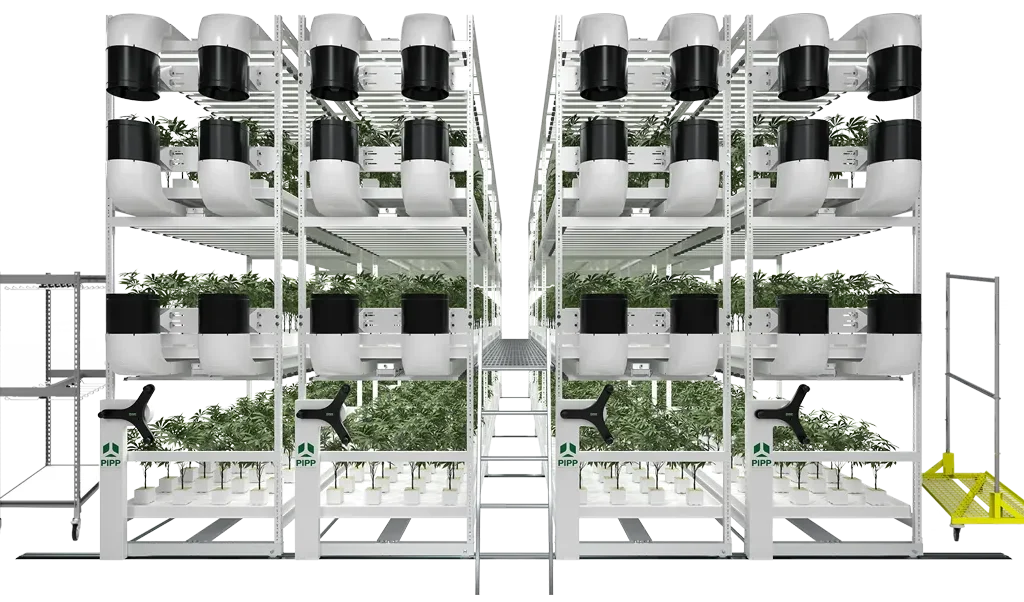
PIPP’s Mobile Vertical Grow System brings together vertical racks, mobile carriages, grow trays, airflow systems, and additional accessories within a configurable cultivation platform.
The goal is not simply maximizing today’s plant count.
It is creating infrastructure capable of supporting how the operation may need to grow tomorrow.
The Future of Indoor Cultivation Is Integrated
Controlled environment agriculture continues to move toward greater precision.
Growers can monitor more environmental variables, collect more plant data, automate more processes, and exert greater control over the cultivation environment than ever before.
But additional technology alone does not guarantee better production.
The next level of optimization comes from understanding how those technologies interact.
Lighting affects plant energy and transpiration.
Airflow affects the microclimate surrounding the leaf.
Irrigation affects the root-zone environment and contributes to the moisture load the facility must manage.
HVACD manages the sensible and latent loads generated by the crop and production equipment.
Plant density affects all of these systems.
Mobility determines how much of the building can become productive canopy while preserving employee access.
And the cultivation structure connects all of them.
From seed to structure, successful indoor cultivation requires looking at the facility as one interconnected system.
By integrating lighting, airflow, HVACD, mobility, irrigation, access, controls, commissioning, and cultivation infrastructure from the beginning, growers can build environments designed not simply to hold more plants—but to support more consistent, scalable, and adaptable production.
The strongest cultivation facilities are not necessarily those with the most equipment or the greatest theoretical canopy. They are the ones where the crop, equipment, infrastructure, environment, and people operate together as one repeatable production system.
For commercial growers evaluating a new facility, expansion, or retrofit, explore PIPP Horticulture’s Mobile Vertical Grow Systems or contact PIPP’s cultivation experts to discuss how an integrated system can fit your operation.
Get a FREE Grow Consultation
Lorem ipsum dolor sit amet, consectetur adipiscing elit. Ut elit tellus, luctus nec ullamcorper mattis, pulvinar dapibus leo.