
10 Signs Your Facility Is Holding You Back (And What It’s Actually Costing You)
You’ve hired good growers. Your genetics are dialed. Your inputs are tight.
And yet production feels like it’s stuck. Labor hours keep climbing. You’re cycling through the same operational headaches every quarter, and “just get more space” keeps coming up in conversations that never seem to go anywhere.
Here’s what we see after working through thousands of commercial cannabis and indoor ag facilities:
Many cultivation facilities operate well below their practical canopy potential, not because the plants cannot fill more space, but because the infrastructure, workflows, and facility layout were never designed to support it fully. Fixed benching, underutilized vertical space, inefficient aisle ratios, and phased build-outs often compound over time until the facility itself becomes the limiting factor.
Fixed benching, inefficient aisle ratios, rigid workflows, staged build-outs that never quite aligned- they all compound quietly until the facility itself becomes the limiting factor.
What follows aren’t early warning signs. They’re operational realities that cost real money every cycle. Here’s how to recognize them and what can actually be done.
1. You're Running Out of Space… But You Haven't Maximized the Space You Have
The most common response to a crowded grow room is to pursue more square footage. New lease, building addition, second facility. The capital expenditure gets justified, the disruption gets absorbed, and production scales modestly.
What rarely gets evaluated first is whether the existing footprint is actually being used efficiently.
In most licensed cultivation facilities, 25–40% of total floor space is dedicated to fixed aisles. In a 20,000 sq ft facility, that’s 5,000–8,000 sq ft of floor space that produces zero canopy, space that still requires HVAC, lighting, and utilities.
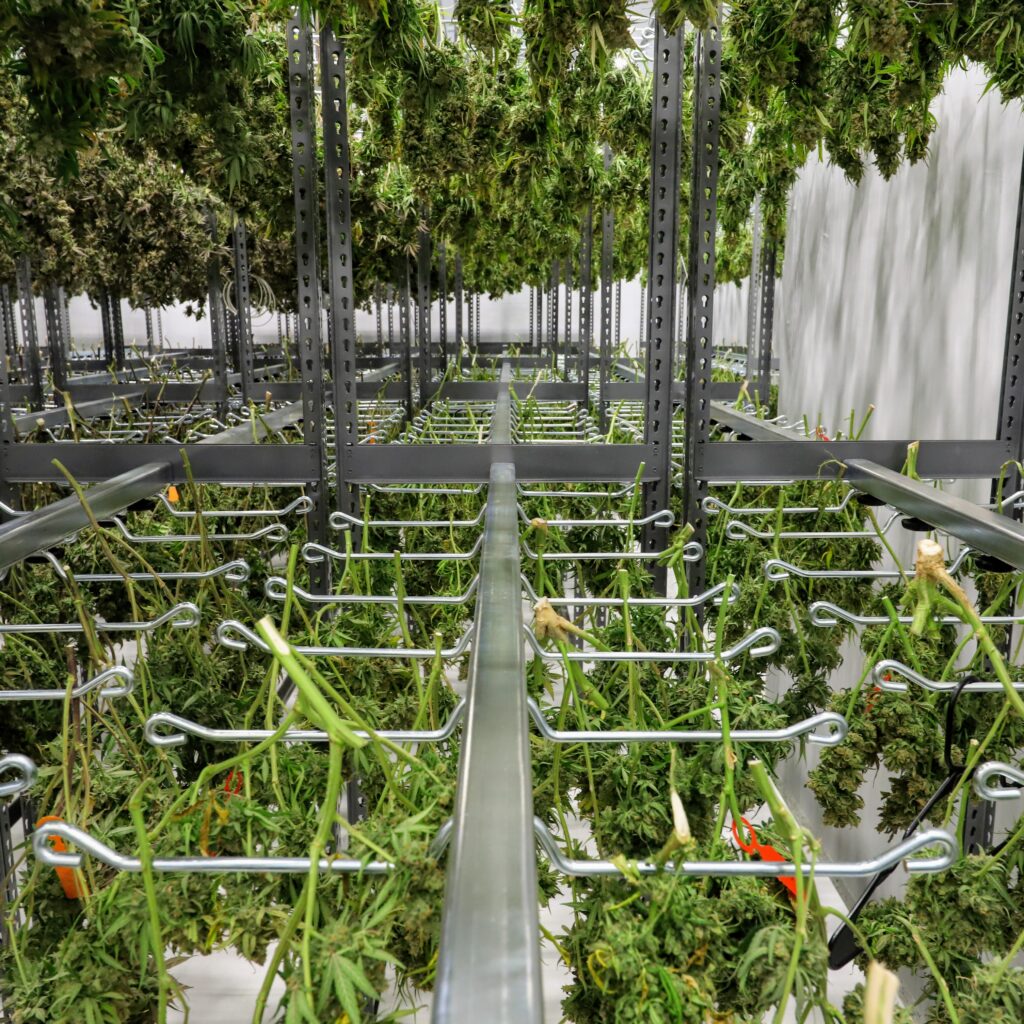
The math on mobile vertical racking is not subtle. A well-configured mobile system reduces required aisle space to a single shared aisle that travels between rows, rather than a dedicated aisle between every bench pair. In practical terms:
- A room configured with fixed benches at a standard 36″ aisle width might yield 60–65% canopy coverage
- The same room with mobile vertical racking can reach 80–90% canopy coverage
- Stacking two or three tiers vertically multiplies usable canopy per square foot by 2–3x
Before committing to a new facility or expansion, a thorough canopy utilization audit of your existing rooms will typically surface more capacity than expected. The most expensive square footage you’ll ever add is the square footage you didn’t need to add. It is important to recognize that increasing canopy density only creates value when the room’s HVACD systems, airflow strategy, irrigation infrastructure, drainage capacity, lighting design, labor access, and crop management practices are capable of supporting the additional plant load.
2. Your Labor Hours per Pound Are Trending in the Wrong Direction
Labor is often one of the largest controllable operating costs in commercial cultivation operations, particularly when cultivation, harvest, post-harvest processing, sanitation, and material handling activities are included. It also tends to be the most opaque, because inefficiency doesn’t show up as a single line item. It shows up as overtime, headcount creep, and a chronic sense that the team is always behind.
The hidden driver of labor inefficiency in most grow facilities isn’t the team; it’s how far and how many times people have to move things.
Walk a plant from clone to harvest in your current facility. Count the handoffs. Count the distances traveled. Count the times a tray, cart, or rack crosses paths with another workflow because the layout doesn’t sequence properly.
In a facility where propagation, veg, and flower aren’t spatially aligned with actual workflow order, a single plant can travel hundreds of feet across its production lifecycle, with multiple employees touching it at every transition. Multiply that by thousands of plants across dozens of cycles, and the labor cost embedded in movement alone is significant.
What efficient facilities do differently:
- Canopy is staged sequentially, propagation adjacent to veg, veg adjacent to flower, with minimal backtracking
- Mobile racking systems allow the grow to come to the workflow, rather than moving plants to fixed workstations
- Harvest, drying, and processing are positioned to receive product in the direction of movement, not against it
The goal isn’t motion for its own sake; it’s eliminating motion that produces no value. A well-designed facility should require fewer labor hours per pound at scale, not more.
3. Your Workflows Have Tribal Knowledge Baked In
This one is harder to see from inside the operation.
When a new employee needs six weeks of shadowing to understand how product moves through the facility, not the growing protocols, but literally how and where things go, that’s a facility design problem presenting as a training problem.
Efficient operations are legible. Workflows follow a logical spatial sequence that new team members can internalize quickly. The physical layout communicates intent: this is where propagation happens, this is how it flows to veg, this is how harvest moves to processing.
When facilities have been built in stages: initial build, then a retrofit, then another wing, workflows often develop organically around physical constraints rather than production logic. The result is a facility that runs on institutional knowledge. The veteran employees carry it. The newer ones are permanently in catch-up mode.
The risk is compounding: high turnover becomes more expensive because onboarding takes longer. Error rates remain elevated during transitions. And the institutional knowledge that keeps the operation running is concentrated in a small number of people, making them single points of failure.
A useful diagnostic: map your actual workflow on paper, not the intended workflow, but what actually happens. If it looks like a spaghetti diagram, the layout is the problem.
4. You're Locked Into a Configuration That Was Right Three Years Ago
Cannabis cultivation in 2026 is not cannabis cultivation in 2018. The market has changed, the genetics have changed, the regulatory environment has changed, and the production strategies that maximize margin have changed with them.
Facilities that were built around specific configurations, fixed tiers designed for a particular canopy height, bench spacing calibrated to a specific strain mix, aisle widths sized for equipment that’s since been replaced, often can’t adapt without major capital expenditure.
The question isn’t whether your facility will need to change. It’s whether it can.
Modular, mobile infrastructure is not about anticipating every future change; it’s about not being locked into past decisions. A cultivation operation that can reconfigure room layouts in days rather than months can respond to market shifts, experiment with production strategies, and adopt new technologies without treating every operational change as a capital project.
The operators who will be best positioned in a consolidating cannabis market are the ones whose facilities are assets, not anchors.

5. You're Paying for Space You Can't Use Productively
Fixed benching systems come with a constraint that rarely shows up in the original equipment justification: the aisle you’re paying for every month.
In a leased facility, every square foot of permanent aisle space incurs carrying costs. At $15–$25/sq ft annual lease rates (common in licensed cannabis markets), a facility where 35% of floor space is aisles is spending $52,500–$87,500 per year per 10,000 sq ft of facility, just on space that holds nothing.
That’s before utilities. HVAC systems treat aisles the same as canopy space. Lighting is typically ratioed to room square footage, not canopy square footage. The cost per gram is being inflated by infrastructure that doesn’t touch a plant.
When properly integrated with the facility’s environmental systems and operational workflows, mobile vertical racking can significantly reduce aisle overhead and increase productive canopy utilization.The conversion math is straightforward: more canopy per square foot means lower cost per gram from the same fixed cost base. In markets where margins are compressing and cost efficiency is a competitive advantage, the facilities running 80%+ canopy efficiency are structurally advantaged over those running at 60%.
6. Your Bottlenecks Have Become Load-Bearing
Every grow facility has pinch points: the transplant station that backs up on Tuesdays, the harvest corridor that can’t handle back-to-back rooms, the drying intake that creates a queue every time a room comes down.
What’s worth paying attention to is whether those bottlenecks have become permanent features of operations rather than problems that get solved.
When teams adapt to bottlenecks, staggering harvest schedules to avoid the corridor congestion, reducing batch sizes to manage transplant backlog, adding a second shift to work around a single-lane processing area, the bottleneck cost becomes invisible. It’s absorbed into headcount, schedule complexity, and reduced throughput per cycle.
The most impactful bottlenecks to audit:
- Harvest corridor capacity — can you run two rooms simultaneously, or does the layout force sequential harvests?
- Transplant station throughput — is the physical setup limiting cycles per day, or is the constraint upstream/downstream?
- Drying and processing intake — is wet weight being staged in the flower room because processing can’t absorb it fast enough?
- Mobile equipment traffic — are carts, forklifts, and personnel competing for the same aisle space at the same time?
Bottlenecks that compound across multiple production stages are typically the highest-ROI targets for facility improvement. Solving one point of congestion often produces outsized gains across the entire cycle.
7. Your Expansion Conversations Never Get Past "How Much Will It Cost"
There’s a pattern in facilities that have genuinely outgrown their infrastructure: expansion feels necessary but the numbers never work. New construction is cost-prohibitive. Leasing adjacent space creates operational complexity. The capital required to expand properly keeps getting deferred.
What that cycle often obscures is that the facility hasn’t been fully utilized yet.
The economics of vertical expansion within an existing facility are consistently more favorable than horizontal expansion. Adding a tier to an existing mobile racking system:
- Costs a fraction of new square footage
- May avoid the expense of acquiring additional real estate, but still requires evaluation of HVACD capacity, electrical infrastructure, irrigation systems, fertigation capacity, lighting layouts, fire and life-safety considerations, and applicable regulatory requirements.
- Can be phased in incrementally rather than committed to all at once
- Increases production without increasing lease/mortgage cost
The constraints are almost always ceiling height and lighting configuration. Facilities with approximately 14 feet or more of clear height may be candidates for multi-tier cultivation systems, depending on crop type, cultivar architecture, lighting strategy, irrigation design, environmental control capabilities, maintenance access requirements, and local code considerations. For facilities already running vertical racking, evaluating whether additional tiers are feasible before pursuing horizontal expansion is almost always worth the analysis.
The most cost-effective grow room you’ll build is probably the one you already have.
8. Your Infrastructure Tells the Story of a Facility Built in Stages
This is one of the most common and least-discussed efficiency problems in established cannabis facilities.
Facilities built in stages: initial license area, then Phase 2, then Phase 3, often have equipment that was right for each phase but was never rationalized into a coherent system. Fixed benching from the original build. Rolling benches were added to Phase 2 because the original supplier was backordered. Vertical racking in Phase 3 from a different manufacturer, with different dimensions and different component compatibility.
The result is a facility where different rooms operate on different logic, sharing equipment becomes a maintenance problem, and scaling best practices from one room to another requires workarounds.
The cost isn’t just operational complexity, it’s the ceiling it puts on continuous improvement. You can’t systematically optimize a facility where every room is a different environment.
The evaluation criteria that matter:
- Are your systems modular and expandable from a single supplier, or is compatibility a recurring problem?
- Can infrastructure be reconfigured by your own team, or does every change require a service call?
- Are the components that wear out- casters, deck surfaces, tier brackets, available and lead-time predictable?
Infrastructure that compounds (each addition builds on and integrates with what came before) is worth paying a premium for. Infrastructure that complicates is worth less than it looks like on paper. Standardization becomes increasingly important as facilities mature. Consistent infrastructure, components, and operating practices simplify training, maintenance, inventory management, and continuous improvement efforts across the operation.
9. You're Scaling Volume Without Scaling Efficiency
Production growth that adds volume without improving cost efficiency is a trap. The facility gets busier, headcount increases, complexity rises, and the per-gram economics stay flat or get worse.
Well-designed cultivation facilities often benefit from economies of scale, where fixed overhead costs and support functions are distributed across a larger productive canopy. However, those benefits are only realized when infrastructure, workflows, environmental controls, and staffing models scale together.
The signature of this pattern in a grow operation: labor hours per pound increase as production increases. What should happen is the opposite. Scaled operations with well-designed infrastructure should see labor hours per pound decrease as volume grows because fixed overhead (facility management, equipment maintenance, environmental monitoring) distributes across more units.
When scaling produces more complexity rather than more efficiency, the facility design is usually not scaling with the production ambition.
Questions worth asking before the next production ramp:
- Can our current infrastructure support 25% more canopy without a proportional increase in labor hours?
- Do our workflows have capacity headroom, or are we already at ceiling?
- Which rooms are performing at target efficiency metrics, and can we replicate that configuration elsewhere in the facility?
Production decisions and infrastructure decisions should be made together, not sequentially. The operators who treat facility design as a constraint to work around will hit the ceiling of that approach eventually.
10. Your Team Is Telling You the Facility Is the Problem
This one deserves more weight than it typically gets in budget conversations.
The people running your operation daily, head growers, lead trimmers, and logistics staff, have more granular visibility into facility inefficiencies than any audit will surface. They know which room runs hot because the aisles are too narrow for airflow. They know which cart route adds 20 minutes to every harvest because two workflows converge in the same corridor. They know which workstation has a back-injury pattern because the ergonomics of the fixture don’t account for how it’s actually used.
This feedback typically surfaces in one-on-ones as vague frustration (“it’s just always chaotic in there”), in exit interviews as a reason for turnover, and occasionally in incident reports. It rarely makes it into capital planning conversations in a form that gets acted on.
What to do with it:
Build a structured mechanism for operational feedback, a quarterly workflow review where team leads document friction points, time-waste observations, and near-misses caused by facility constraints. Quantify where possible (how many minutes of travel per harvest? how often does transplant station back up?). That data, accumulated over two or three cycles, becomes the justification for infrastructure investment that board members and financial stakeholders can evaluate.
Your team isn’t complaining. They’re telling you where the money is.
What Comes Next
The facilities that will win the next five years of commercial cannabis and CEA are the ones that treat infrastructure as a strategic asset rather than a fixed cost.
That doesn’t mean rebuilding. It means honestly evaluating where canopy efficiency, labor efficiency, and workflow design are leaving yield and margin on the table, and closing those gaps systematically.
At Pipp Horticulture, this is the work we do alongside cultivation operators every day: evaluating facilities through the lens of canopy utilization, labor efficiency, workflow design, environmental performance, and long-term scalability. Our goal is not simply to add more canopy, but to help operators build systems that improve productivity, consistency, and profitability over time.
If your facility is showing any of the signs above, the conversation worth having is what optimization would actually look like for your specific footprint, production model, and growth goals.
Book a consultation with our facility design team. We’ll provide an objective assessment of what is working, what may be limiting performance, and where optimization efforts are most likely to generate meaningful operational and financial returns.
Related resources: Signs Your Facility Has Outgrown Its Layout | The Future of Indoor Growing Equipment: A Realistic Look (Podcast)
Get a FREE Grow Consultation
Lorem ipsum dolor sit amet, consectetur adipiscing elit. Ut elit tellus, luctus nec ullamcorper mattis, pulvinar dapibus leo.