
Design Facilities That Pass Compliance Audits
Most cannabis facilities fail their first compliance audit. Not because the business is bad, but because the building was designed without the audit in mind.
In regulated cannabis, the building itself becomes part of the compliance system. Your floor plan, environmental strategy, security layout, electrical infrastructure, operational workflows, and documentation systems all directly influence whether you pass inspection, maintain your license, and operate efficiently long term.
The most successful operators design for compliance, operational flow, scalability, and audit readiness simultaneously from day one, not after construction is complete.
This guide fixes that. It walks you through every layer of compliant facility design, from security camera angles to canopy calculations, so you can walk into inspection day with confidence.
In this blog, we will go over:
01 Knowing your regulatory layers before you draw a single line
02 Physical security design that satisfies every checklist
03 Seed-to-sale traceability built into your floor plan
04 Environmental controls and the paper trail auditors want
05 Your pre-audit walkthrough checklist
1. Know your regulatory layers before you draw a single line
Cannabis facilities answer to three distinct sets of rules at the same time: state licensing requirements, local zoning and building codes, and federal guidelines when banking or interstate commerce is involved. The trap most operators fall into is designing for one layer and ignoring the others.
Before your architect touches a floor plan, pull the actual license application from your state cannabis authority. That document is your primary design brief. Every room type, minimum square footage, buffer zone, and egress path they require should become a constraint in your design program, not an afterthought.
Critical first step: Cross-reference your state’s cannabis facility regulations with your local fire marshal’s requirements and your building department’s occupancy classifications. Conflicts between them are common and must be resolved before permitting, not during inspection.
Inspectors typically evaluate:
- Camera coverage and blind spots
- Video retention capability
- Access control segregation
- Visitor management procedures
- Alarm functionality
- Vault construction requirements
- Monitoring and response protocols
- Loading and receiving security
- Employee-only restricted areas
Local municipalities often add requirements on top of state rules. Proximity to schools, churches, or parks. Signage restrictions. Odor mitigation ordinances. Parking ratios tied to your license type. Map every applicable rule to a specific part of your design before schematic design begins.
2. Physical security design that satisfies every checklist
Security is where most facilities rack up the most violations. Regulators walk a site looking for gaps in surveillance, access control failures, and alarm system deficiencies. They do not give credit for intention. If the camera does not cover the zone, the zone is unsecured.
Design your surveillance system around coverage requirements first. Most states specify minimum resolution, retention periods (commonly 90 days), and every area that must be covered: point of sale, vaults, safes, cultivation canopy, all entries and exits, and loading/unloading areas. Map camera fields of view on your floor plan during design. Do not leave this to the security integrator after walls go up.
Common violation: Cameras installed at angles that create blind spots at vault doors and entry points. Always verify coverage in your as-built drawings before requesting inspection.
Access control must be layered to match your license type. Separate access levels are typically required between public-facing areas, employee work areas, restricted processing or cultivation areas, and vaults. Each boundary needs a logged entry mechanism, and those logs need to be exportable for regulators on demand.
- Camera coverage mapped to floor plan before rough-in
- Minimum resolution and retention period confirmed with state requirements
- Access levels documented and keyed to license type requirements
- Alarm system tied to monitoring service with response time documentation
Vault meets UL rating required by your state
3. Seed-to-sale traceability built into your floor plan
Traceability is not just a software problem. It is a physical flow problem. Regulators check whether your facility’s movement of plants and products actually matches what your track-and-trace system records. When those two things conflict, you fail.
Design your floor plan so product movement is linear and logical. Plants should move in one direction through propagation, vegetation, and flowering. Harvest should flow to processing without passing back through cultivation. Packaged product should have a clear path from the processing area to the secure storage vault, and from there to the point of sale or delivery staging area.
Design Around Auditability
Inspectors are increasingly evaluating whether physical operations align with digital inventory records.
That means:
- Doorways and room transitions should support inventory reconciliation
- Scan events should correspond to operational handoff points
- Waste staging should be isolated and documented
- Quarantine areas should be clearly designated
- Vault storage should support organized reconciliation processes
Facilities that lack organized movement patterns often experience:
- Inventory discrepancies
- Labor inefficiency
- Product mix-ups
- Diversion risk
- Delayed reconciliations
- Increased audit exposure
Design principle: Every state-required plant tag scan or inventory reconciliation event should correspond to a physical doorway or handoff point in your facility. If your METRC or BioTrackTHC workflow has 6 scan events, your floor plan should have 6 clear transition points.
Waste destruction is a high-scrutiny area. Designate a dedicated waste staging and destruction area. It should be accessible from cultivation and processing without passing through sales or public areas. The space needs camera coverage and a logbook or digital entry system. Regulators often walk this area specifically because it is where diversion risk is highest.
4.Environmental controls and the paper trail auditors want
Auditors checking cultivation facilities want to see that your HVAC, lighting, and irrigation systems are controlled, monitored, and documented. They are not necessarily judging your grow style. They are confirming that your facility cannot be used to produce unlicensed product without detection, and that your environmental conditions match your stated canopy and plant counts.
Install environmental monitoring with data logging from day one. Temperature, humidity, and CO2 at a minimum. Some states require this as a license condition. Even where it is not required, it protects you: if a regulator questions your yield numbers, logged environmental data is part of your defense.
Odor control: Odor violations are among the most common causes of license suspension after approval. Size your carbon filtration and negative pressure system based on your full canopy, not your current canopy. Regulators and neighbors will hold you to the standard regardless of how full your rooms are
For electrical systems, make sure your design accounts for the actual draw of your lighting, dehumidification, and supplemental CO2 equipment. Under-designed electrical infrastructure forces operators to run equipment below spec or daisy-chain circuits, both of which create fire code violations and red flags during inspection.
- Data-logged environmental monitoring in all cultivation areas
- Negative pressure confirmed in cultivation and processing rooms
- Carbon filtration sized for licensed canopy, not current canopy
- Electrical panel capacity matches equipment load calculations
Water/irrigation system meets local backflow prevention requirements
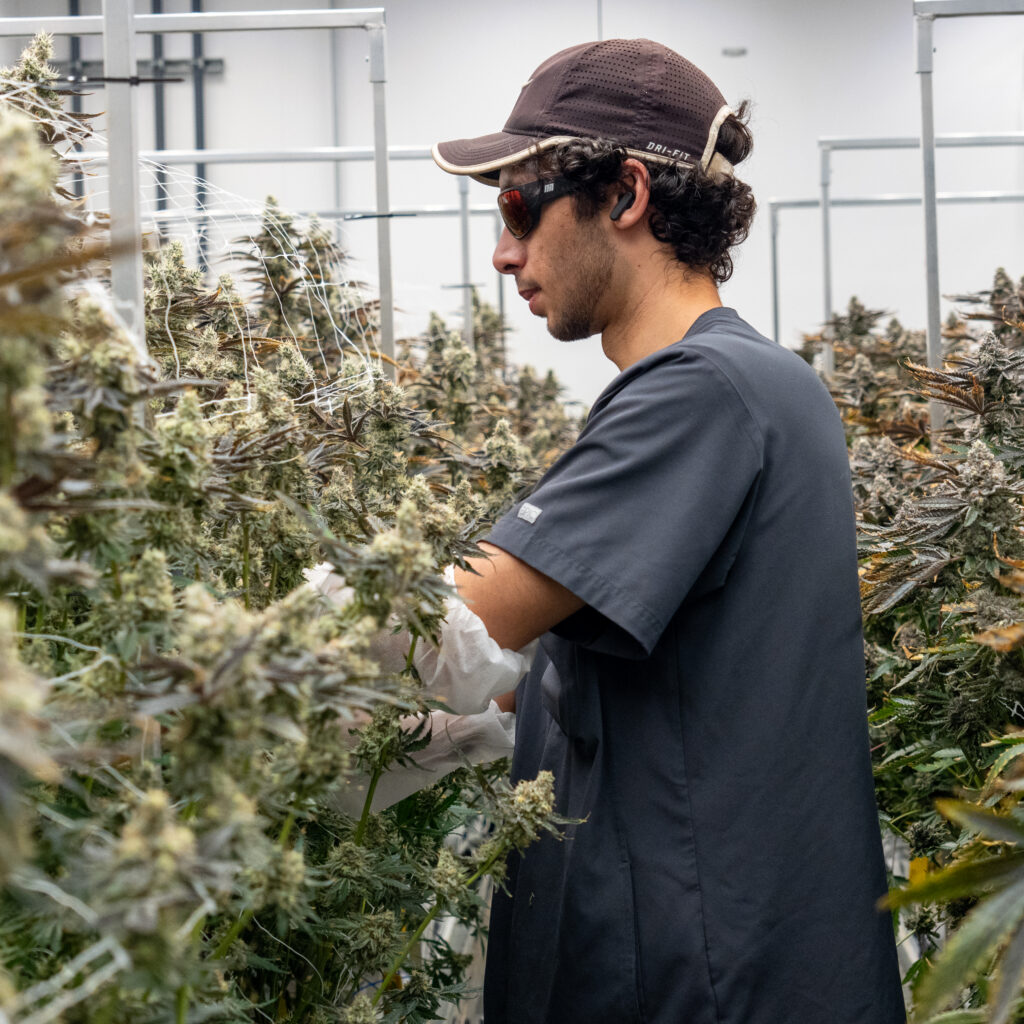
5. Environmental and Lighting Uniformity Is Hard to Maintain
Layout inefficiencies can also impact environmental consistency.
In crowded rooms with inconsistent spacing, airflow patterns can become uneven. Certain areas may experience stagnant air, while others receive excessive circulation. Lighting uniformity can also suffer when plant rows are squeezed into layouts that weren’t originally designed to support higher canopy density.
Over time, these inconsistencies can lead to:
- Uneven plant growth
- Microclimate pockets within the canopy
- Variations in yield across the room
These issues are often compounded in high-density environments where airflow design has not been adjusted to match the canopy structure. Target air velocities, distribution patterns, and dehumidification capacity must all be aligned with plant density to maintain uniform conditions across the room.
When growers notice that plants perform differently depending on where they’re located in the room, it may be a sign that the layout is no longer supporting uniform cultivation conditions.
Increasing canopy density without adjusting HVACD and airflow strategy can lead to elevated disease pressure, inconsistent transpiration rates, and variability in final product quality.
Your pre-audit walkthrough checklist
Two weeks before any scheduled inspection, walk your facility the way a regulator would. Start at the property line and work inward. Check your buffer zone measurements. Confirm your exterior signage meets specifications. Walk through every camera zone. Pull up your surveillance footage and verify it is recording and accessible.
Check that your standard operating procedures binder is current, signed, and physically on-site. Most states require SOPs to be available during inspection for areas including security, inventory management, employee training, waste disposal, and sanitation. If they were last updated 18 months ago, update them before the auditor asks.
Paper trail matters: An auditor’s job is to verify that what you say you do matches what you actually do. Your employee training logs, waste destruction records, inventory reconciliation reports, and visitor logs are the evidence. If those documents are incomplete or inconsistent with your track-and-trace data, no amount of facility quality will save you.
- Buffer zone measurements documented and photos on file
- Live surveillance feed tested and recording verified
- SOPs printed, current, and signed by current staff
- Employee training logs current and on-site
- Inventory in track-and-trace matches physical count
- Waste destruction logs complete and reconciled
- Visitor log up to date with all recent regulatory visits
- License certificate posted in required public location
Build it right before you build it
The single most expensive mistake in cannabis is designing a facility and then discovering what compliance actually required. Use this blog as your pre-design checklist, not your post-violation repair manual.
See how Pipp Horticulture’s vertical racking systems are designed to meet compliance requirements from the ground up. Talk to a specialist.
Get a FREE Grow Consultation
Lorem ipsum dolor sit amet, consectetur adipiscing elit. Ut elit tellus, luctus nec ullamcorper mattis, pulvinar dapibus leo.